







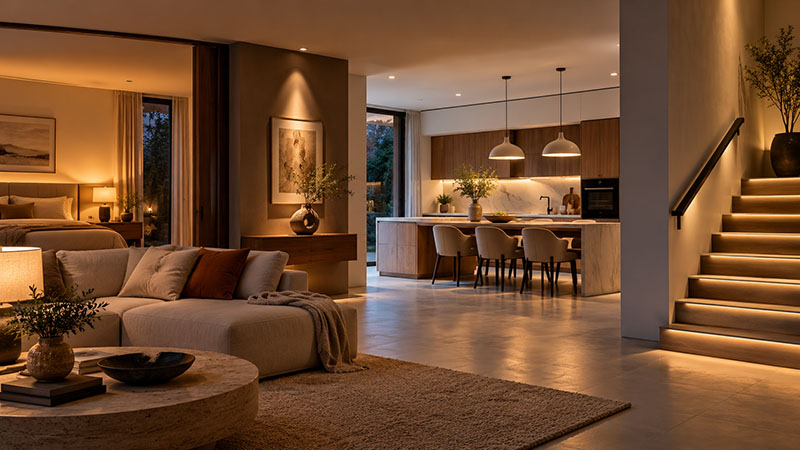
In residential projects, lighting is often addressed in the final stages of the design process. However, light is one of the most important elements that determines how a space feels, how colors are perceived, and how comfortable users feel within the environment.
Proper lighting design is not simply about providing sufficient illumination levels. The angle of light, color temperature, color rendering performance, and light distribution throughout the space should all be considered together.
Below are some of the key factors that stand out in successful residential lighting design.
Glare Control Is Essential for Visual Comfort
Modern living spaces commonly feature glass surfaces, polished stone, television screens, metal details, and glossy furniture. Uncontrolled light distribution can create disturbing reflections and glare on these surfaces.
In such cases, the solution is not always to use higher light output. What matters most is directing the light accurately toward the area where it is needed.
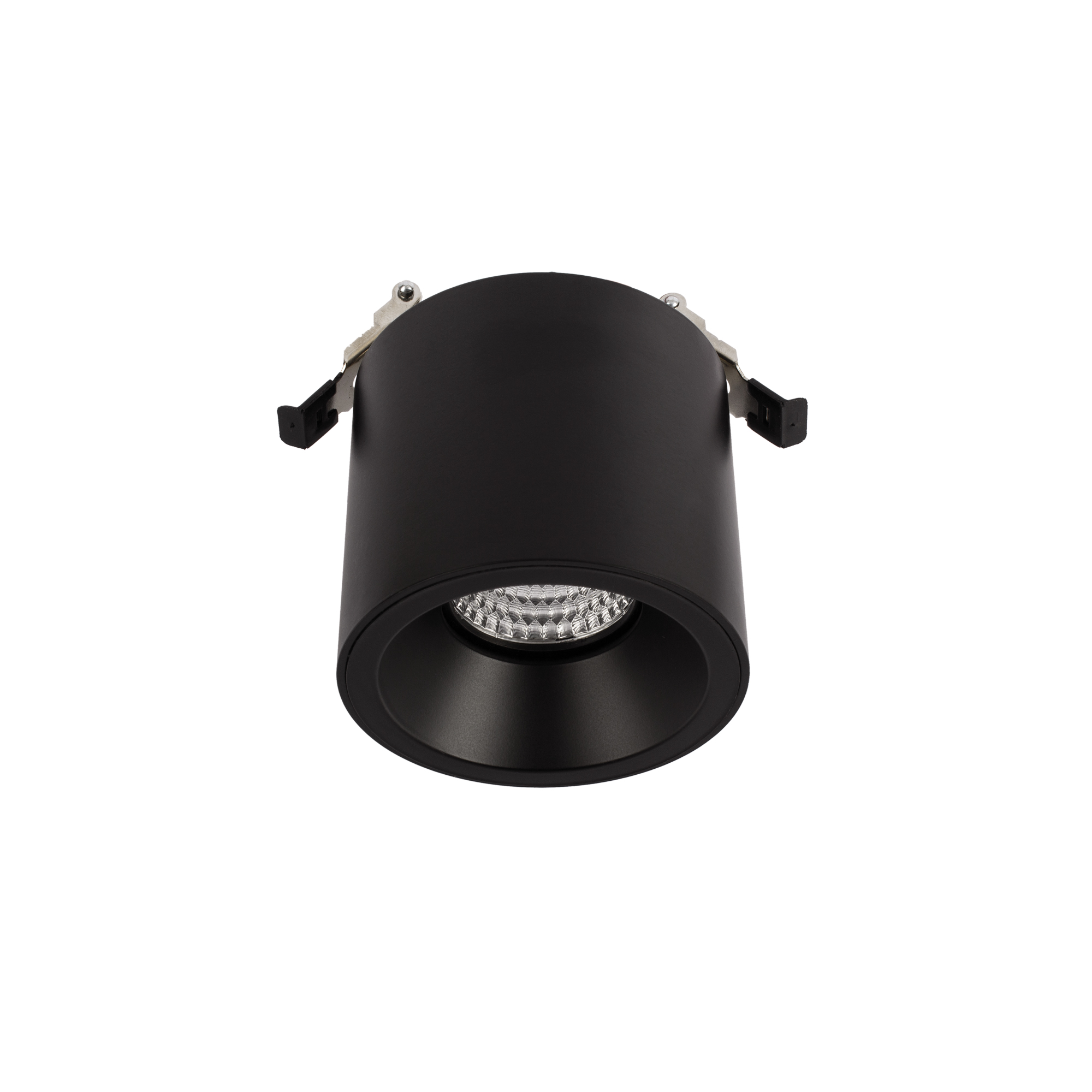
Especially in accent lighting applications, 15°–30° narrow-beam COB LED optics help focus the light precisely on the intended surface. This allows architectural details to be highlighted while reducing unwanted reflections.
The goal of good lighting design is not to make the light itself noticeable, but to make its effect on the space perceptible.
The Same Color Temperature Should Not Be Used in Every Space
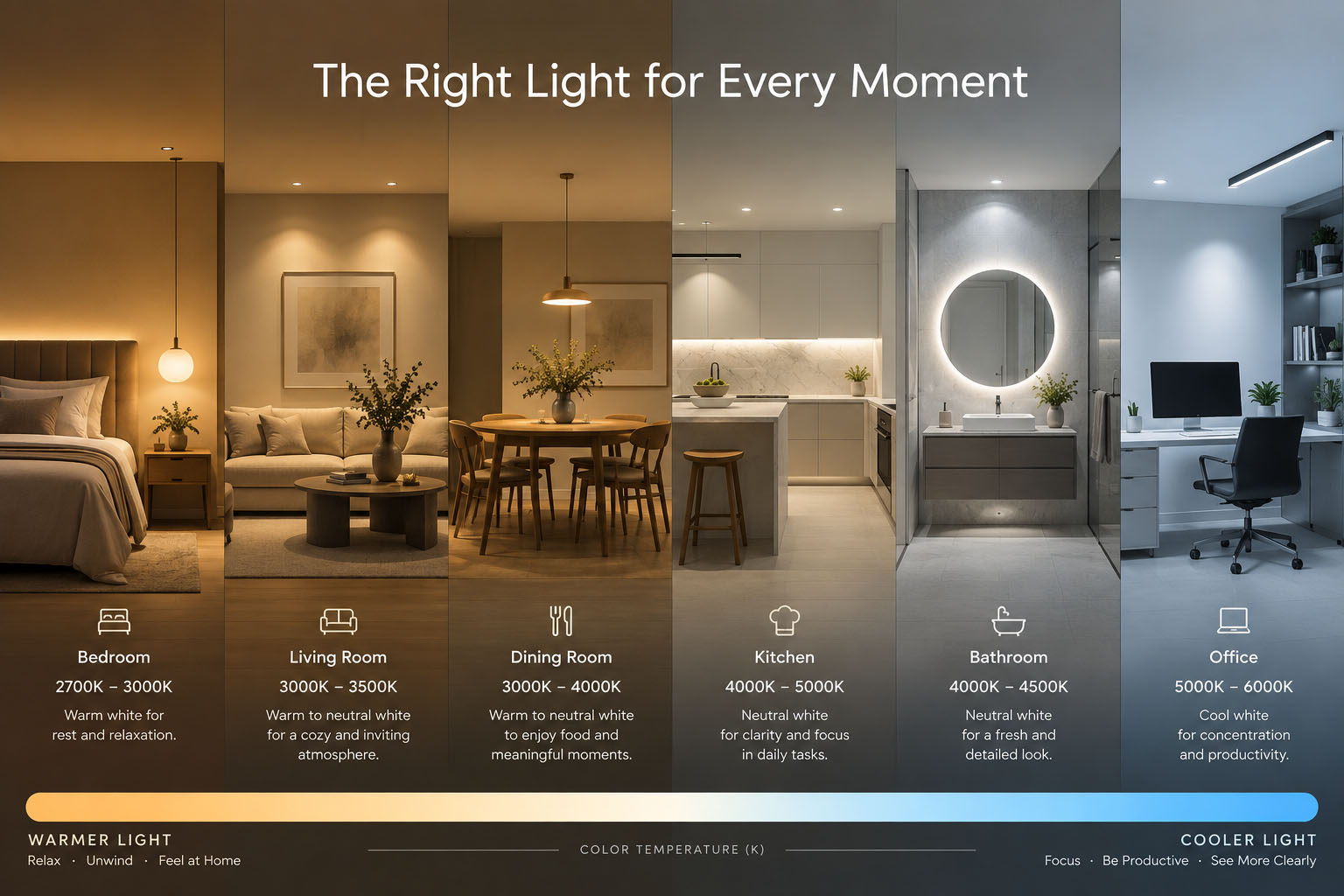
One of the common mistakes in residential lighting is using the same color temperature throughout all areas. However, bedrooms, kitchens, workspaces, and bathrooms serve different purposes.
CCT (Correlated Color Temperature) refers to how warm or cool white light appears and is measured in Kelvin (K).
Lower Kelvin values create a warmer and more relaxing atmosphere, while higher Kelvin values provide a more neutral and dynamic lighting effect.
For example, warm white light in the 2700K–3000K range can be preferred in bedrooms and living areas. In kitchens and workspaces, color temperatures in the 3000K–4000K range can be considered to create a clearer environment that supports concentration and visual performance.
When selecting the appropriate CCT, factors such as the type of room, amount of natural daylight, surface colors, materials, and the intended use of the space should all be taken into account.
R9 Performance Is Just as Important as CRI
One of the key criteria used to evaluate lighting quality is the CRI (Color Rendering Index).
Light sources with a high CRI help objects and surfaces appear more natural and true to their actual colors. For this reason, products with a CRI Ra>90 offer a significant advantage in residential projects.
However, looking only at the general CRI value is not always sufficient.
The R9 value, in particular, indicates how accurately saturated red tones are reproduced. Human skin tones, food, wooden surfaces, and many decorative materials contain red components, making R9 performance especially important in residential lighting.
Therefore, in areas such as bathrooms, dressing rooms, dining rooms, and kitchens, where natural color appearance is particularly important, the R9 value should be evaluated together with CRI.
The right question is not only, “How much light does it provide?” but also, “How accurately does it render colors?”
Lighting in Staircases and Transitional Areas Is a Safety Element
Staircases, corridors, and circulation areas can sometimes receive less attention in residential projects. However, proper lighting in these spaces is critical for both user comfort and safety.
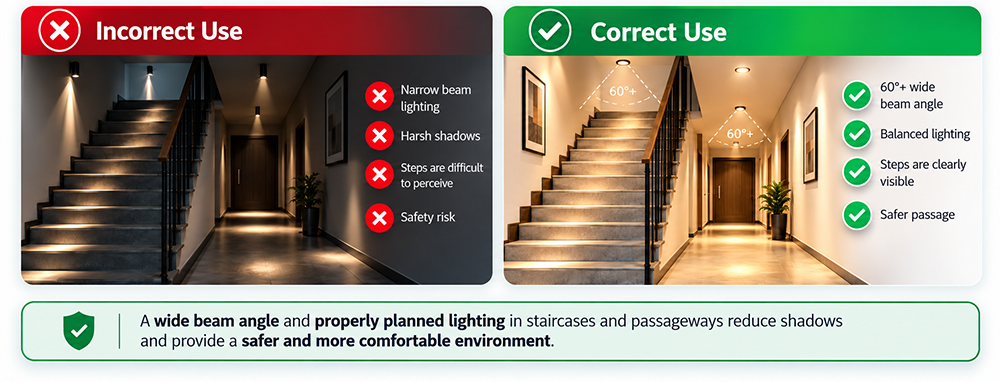
Insufficient or poorly positioned lighting can create harsh shadows on steps, making depth perception more difficult.
In such areas, wide-beam light distributions of 60° and above help spread the light more evenly. This makes steps easier to perceive while reducing harsh shadows.
Well-planned staircase and circulation lighting is not merely a decorative feature; it is also a functional solution that helps make everyday life safer.
Good Lighting Is Not About More Light, but the Right Light
Successful residential lighting cannot be defined by lumen values alone.
Glare control, beam angle, color temperature, CRI and R9 performance, and the distribution of light throughout the space should all be evaluated together.
Well-designed lighting supports the architecture, reveals the true character of materials, improves visual comfort, and enhances the overall atmosphere of living spaces.
For this reason, lighting solutions should focus not only on which light source is used, but also on where, how, and why the light is used.
The right light does more than illuminate a space; it changes the way the space feels.
Other Blog Other Posts